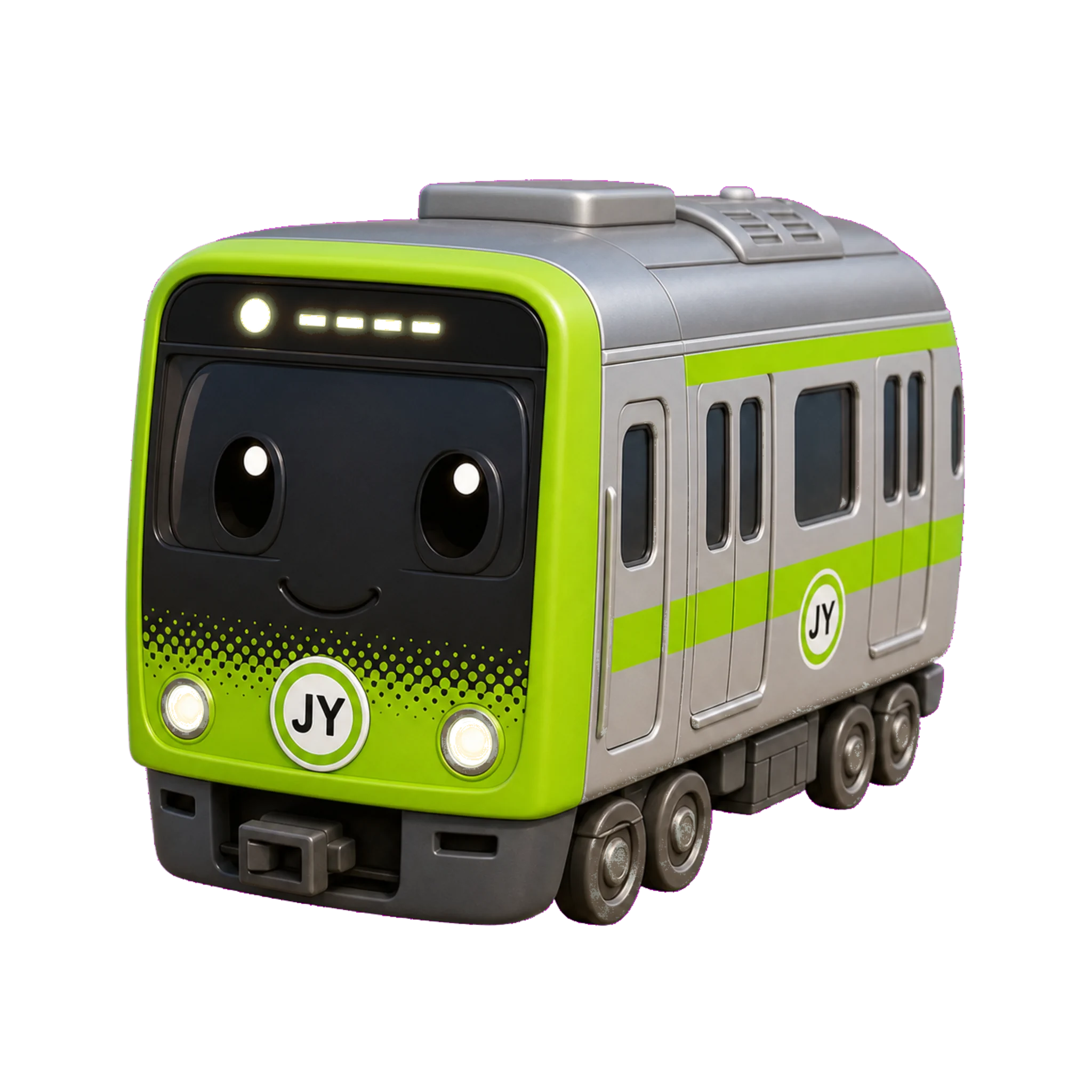

Overview
The Yamanote Line (JY) is JR East's loop around central Tokyo — about 34.5 km, 30 stations, and this game's flagship line, most players' very first ride. Trains have no true terminus: only uchi-mawari (counterclockwise: Tokyo → Ueno → Ikebukuro → Shinjuku → Shibuya → Shinagawa) and soto-mawari (clockwise). Miss your stop and you'll simply come back around.
A full circuit takes about an hour, and at peak times trains run barely two minutes apart. That frequency is the reason the loop functions less like a line and more like a moving ring road: almost every other line in Tokyo is built to touch it somewhere, which is why 26 of its 30 stations connect to something else in this game.
Along the route
From Tokyo Station the line threads Akihabara's electronics and anime district, Ueno's museum quarter, the mega shopping complexes of Ikebukuro, the skyscrapers and neon of Shinjuku, the youth culture of Harajuku and Shibuya, and finally the Shinkansen hub at Shinagawa — one loop, and nearly every facet of Tokyo's personality.
The loop is also a good short history of the city. The eastern arc through Kanda and Ueno follows the oldest built-up ground; the western arc through Shinjuku and Shibuya was farmland when the line opened and is now the busiest transport corridor on earth. Takanawa Gateway, opened in 2020 between Shinagawa and Tamachi, was the line's first new station in nearly half a century, and its katakana name is the only one on the loop that isn't written in kanji.
Where the typing gets hard
Thirty station names, 248 keystrokes, an average of 8.3 per stop — a mid-length run with two genuinely awkward stretches.
The first is Takanawa Gateway (takanawage-towei), by far the longest name on the loop at 16 keystrokes. It is the only station here written in katakana, and the long vowel mark ー is typed as a plain hyphen — a key most players do not expect to need mid-word, and the single most common place to stall on a first attempt.
The second is the Nippori / Nishi-Nippori pair, back to back at stops 7 and 8. Both carry a small っ (nippori, nishinippori), so the double p has to land twice in a row while your eyes are already on the next name. Doubling a consonant is easy; doing it twice in eight seconds is where the mistakes come from.
After that, watch the long-vowel names: Hamamatsucho (hamamatsuchou, 13), Yurakucho (yuurakuchou) and Tokyo itself (toukyou) all need the extra u that the printed romaji does not show. Five stations on the loop contain a small ゃ/ゅ/ょ, and all of them accept both spellings — shinjuku or sinzyuku, harajuku or harazyuku.
The relief is the eastern arc: Ueno (4 keystrokes), Kanda, Tabata and Sugamo are among the shortest names in the game, and they arrive in a cluster.
How to practise it
Start at Tokyo in the uchi-mawari direction for your first runs. It is the canonical circuit, it puts the short eastern names first while you settle into rhythm, and it saves Takanawa Gateway for the last third when you are warm.
Once that is comfortable, run it soto-mawari from the same station. The name order reverses but the muscle memory does not transfer as cleanly as you would expect, which is exactly the point — clockwise is the better test of whether you actually know the loop or have just memorised a sequence.
Because a loop run always returns to where it started, your start station does not change the length of the run. Every Yamanote time is comparable to every other one, whichever platform you began on.
Why play it
Thirty stations form a naturally graded run of increasing difficulty — from short names like "tokyo" to longer challenges like "nishi-nippori" and "takanawa-gateway" — and it's the best line for practicing both loop directions.
Line data
Everything below is derived from the station data the game runs on, so it always matches what you actually type on the 山手線 — all 30 stops of it.
- Operator
- JR East
- Line symbol
- JY
- Stations
- 30
- Shape
- Loop line
- Termini
- No terminus — the loop returns to 東京
How much typing is this?
Typing every station name on this line takes 248 keystrokes, an average of 8.3 per station. The longest name is 高輪ゲートウェイ (takanawa-gateway) at 16 keystrokes; the shortest is 上野 (ueno) at 4. Those counts come from running each name's kana through the game's own romaji engine, so they are what your fingers actually do — not the length of the printed spelling.
Along the way: 2 names contain a small っ, which doubles the next consonant; 5 contain a small ゃ, ゅ or ょ, where the engine accepts both the Hepburn and Kunrei spellings (sha or sya, shu or syu); and 0 end in ん, whose trailing n folds into whatever comes next rather than standing alone.
Where you can change trains
26 of the 30 stations on this line connect to another line in the game. Follow any symbol to that line's guide.
- 東京M 丸ノ内線JC 中央線JK 京浜東北線JO 総武快速・横須賀線JT 東海道線JU 宇都宮線JE 京葉線
- 神田G 銀座線JC 中央線JK 京浜東北線
- 秋葉原H 日比谷線JB 中央・総武線各駅停車JK 京浜東北線
- 御徒町JK 京浜東北線
- 上野G 銀座線H 日比谷線JK 京浜東北線JU 宇都宮線JJ 常磐線快速
- 鶯谷JK 京浜東北線
- 日暮里NT 日暮里・舎人ライナーJK 京浜東北線JJ 常磐線快速
- 西日暮里C 千代田線NT 日暮里・舎人ライナーJK 京浜東北線
- 田端JK 京浜東北線
- 駒込N 南北線
- 巣鴨I 三田線
- 池袋M 丸ノ内線Y 有楽町線F 副都心線JS 湘南新宿ラインJA 埼京線
- 高田馬場T 東西線
- 新宿M 丸ノ内線S 新宿線E 大江戸線JC 中央線JB 中央・総武線各駅停車JS 湘南新宿ラインJA 埼京線
- 代々木E 大江戸線JB 中央・総武線各駅停車
- 渋谷G 銀座線Z 半蔵門線F 副都心線JS 湘南新宿ラインJA 埼京線DT 田園都市線
- 恵比寿H 日比谷線JS 湘南新宿ラインJA 埼京線
- 目黒N 南北線I 三田線
- 五反田A 浅草線
- 大崎JS 湘南新宿ラインJA 埼京線
- 品川JK 京浜東北線JO 総武快速・横須賀線JT 東海道線
- 高輪ゲートウェイJK 京浜東北線
- 田町JK 京浜東北線
- 浜松町JK 京浜東北線
- 新橋G 銀座線A 浅草線JK 京浜東北線JO 総武快速・横須賀線JT 東海道線
- 有楽町Y 有楽町線JK 京浜東北線
Marked with a star: 東京・上野・池袋・新宿・渋谷・品川・新橋 — the major interchanges, which the maps always label and the game marks with a heavier arrival stamp.
Every station on the line
All 30 stations in order, with the official station number, the name in kanji, the kana the typing is derived from, and its Hepburn romaji.
| # | No. | Station | Kana | Romaji |
|---|---|---|---|---|
| 1 | JY01 | 東京 | とうきょう | tokyo |
| 2 | JY02 | 神田 | かんだ | kanda |
| 3 | JY03 | 秋葉原 | あきはばら | akihabara |
| 4 | JY04 | 御徒町 | おかちまち | okachimachi |
| 5 | JY05 | 上野 | うえの | ueno |
| 6 | JY06 | 鶯谷 | うぐいすだに | uguisudani |
| 7 | JY07 | 日暮里 | にっぽり | nippori |
| 8 | JY08 | 西日暮里 | にしにっぽり | nishi-nippori |
| 9 | JY09 | 田端 | たばた | tabata |
| 10 | JY10 | 駒込 | こまごめ | komagome |
| 11 | JY11 | 巣鴨 | すがも | sugamo |
| 12 | JY12 | 大塚 | おおつか | otsuka |
| 13 | JY13 | 池袋 | いけぶくろ | ikebukuro |
| 14 | JY14 | 目白 | めじろ | mejiro |
| 15 | JY15 | 高田馬場 | たかだのばば | takadanobaba |
| 16 | JY16 | 新大久保 | しんおおくぼ | shin-okubo |
| 17 | JY17 | 新宿 | しんじゅく | shinjuku |
| 18 | JY18 | 代々木 | よよぎ | yoyogi |
| 19 | JY19 | 原宿 | はらじゅく | harajuku |
| 20 | JY20 | 渋谷 | しぶや | shibuya |
| 21 | JY21 | 恵比寿 | えびす | ebisu |
| 22 | JY22 | 目黒 | めぐろ | meguro |
| 23 | JY23 | 五反田 | ごたんだ | gotanda |
| 24 | JY24 | 大崎 | おおさき | osaki |
| 25 | JY25 | 品川 | しながわ | shinagawa |
| 26 | JY26 | 高輪ゲートウェイ | たかなわげーとうぇい | takanawa-gateway |
| 27 | JY27 | 田町 | たまち | tamachi |
| 28 | JY28 | 浜松町 | はままつちょう | hamamatsucho |
| 29 | JY29 | 新橋 | しんばし | shimbashi |
| 30 | JY30 | 有楽町 | ゆうらくちょう | yurakucho |